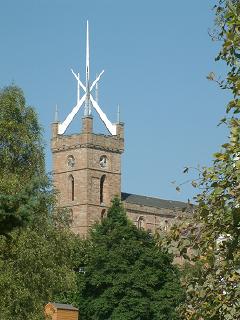
St. Michael's Parish Church, with its distinctive tower, dominates the town of Linlithgow. Lying on a promontory between the town and the loch, next to the palace, it is almost of cathedral proportions and considered one of the finest mediaeval churches in Scotland.
The earliest record of the Great Church of Linlithgow is its gift, in 1138, to the Bishop of St. Andrews by King David I (c.1080 - 1153). In 1242, David de Bernham, another Bishop of St Andrews, consecrated the church. However, in 1301, it was used as a store-house by King Edward I of England during his invasion, causing considerable damage. Further devastation came with a serious fire in 1424. The church was reconstructed over the next 116 years, supported by the Stewart Kings, giving rise to the present structure. At this time a crown-topped steeple was constructed, not dissimilar to that on St. Giles in Edinburgh. However, in 1821 the crown was determined to be unsafe and removed. In 1964 a controversial replacement was added, which was meant to represent Christ's 'crown of thorns' but has been described as 'a wigwam without its cover'.
The Protestant Lords of the Congregation marched from Perth arriving at St. Michael's on the 29th June, 1559. It was the height of the Reformation and they vented their fury on the altars and fine sculpture, intent on obliterating all traces of the Roman Catholic religion. Only one statue survived, that of St. Michael, Patron Saint of both church and burgh. Further damage occurred when Oliver Cromwell's troops were billeted in the church in 1646, with their horses stabled in the nave. Changes were made in the early 19th C. when the roof was found to be close to collapse; the 16th C. ceiling was pulled down and the interior badly remodelled. A further significant alteration of the interior took place between 1894-96, when the church closed for two years to allow galleries (or 'lofts') once owned by royalty, local landowners and trade guilds to be removed, stonework was modified, the level of the floor lowered to its original level, new pews provided and the pulpit moved to the side. The pulpit echoes the royal associations of the church; featuring wood-carved figures of Queen Margaret, Queen Mary, Queen Victoria and Queen Elizabeth II.
There are fine stained glass windows, including one in memory of the oceanographer Charles Wyville Thomson (1830-82), installed in 1885, and another fitted in St. Katherine's Aisle in 1992, in celebration of the 750th anniversary of the church. It was in St. Katherine's Aisle that King James IV (1473 - 1513) had knelt before going to the Battle of Flodden and had a vision of his imminent death. His Queen is said to have wept at a mass in the church when she realised her husband would not return. Today, many mediaeval features are still extant, including the remains of a holy-water stoup, panels from the original altar and mason's marks on the stone-work. Within the tower hang three named bells: the oldest Alma Maria was cast in 1490 and weighs 508kg (1120 lbs), the others are Meg Duncan (recast in Holland 1719 after a crack developed) and Santo Michael Archangelo (originally dating from 1484, but recast in London in 1773 after it cracked).
A new organ was installed in 2001. This comprises a sizeable two-manual instrument by Henry Willis & Sons, built in 1912 for the chapel in Queen Ethelburga's School in Harrogate (Yorkshire) which closed in 1991. The organ was altered to suit St. Michael's by Michael Copley of Surrey.
To the right of the West Door is a Mediaeval statue of St. Michael and a leper's squint, which allowed those with infectious diseases to view the service without infecting the congregation. Before the Anatomy Act of 1832, resurrectionists were at work in the kirkyard, removing recently-buried corpses to take to anatomists in Edinburgh. A mort-safe was purchased in 1819 but this proved an insufficient deterrent as watchmen had to be appointed from 1823.