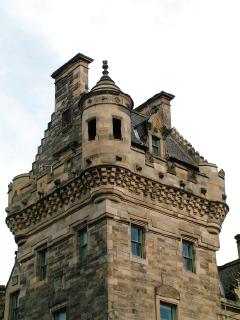
A fine compact baronial edifice located 1¼ miles (2 km) southeast of central Edinburgh, St. Leonard's Hall is home to administrative offices and function suites associated with the University of Edinburgh's Pollock Halls of Residence. The house was designed in 1870 by architect John Lessels (1808-83) for the publisher Thomas Nelson (1822-92), whose Parkside Printing Works lay on the opposite side of Holyrood Park Road. It was built on the site of an earlier house, known as Arthursley. Nelson's brother and partner, William (1816-87), lived at Salisbury Green, immediately to the south. St Leonard's is a rich example of the Scottish Baronial style, with pepper-pot turrets and a tower with corbelled-out bartizans and a cap-house which is said to be reminiscent of a Highland croft-house.
Inside there are dark Neo-Jacobean ceilings and stencilled panels by Thomas Bonnar (1810-73), featuring Nelson's initial inscribed alongside those of his wife and medallions featuring the Duke of Argyll, the Earl of Moray, the Duke of Montrose and John Knox. A grand ornate carved wooden staircase, featuring birds and animals, said to have been based on an original in Kinross House.
The building was used as a Red Cross Hospital during World War I and thereafter served as the St. Trinnean's School for Girls until the Second World War, during which it became an Air Raid Precautions (ARP) and Home Guard Headquarters. This school provided the inspiration for Ronald Searle's books and a quartet of classic British comedy films beginning with The Belles of St. Trinian's in 1954. This episode is remembered by the St. Trinnean's Room, one of the function rooms in the building.
Following the purchase of the site by Sir Donald Pollock and its gift to the University, St. Leonard's became a hall of residence for female students. By the late-1960s, when modern halls were completed, it became the administrative centre for the complex. A sympathetic internal restoration was completed post 2000.