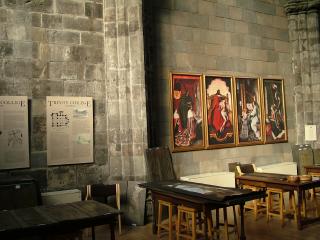
Located towards the southern end of Edinburgh's High Street - the middle section of the Royal Mile - the Brass Rubbing Centre lies in the reconstructed 15th Century Apse of Trinity College Church. Inside, it can still be seen that this was the grandest of the Scottish Collegiate churches.
The Brass Rubbing Centre, which is run by the city council, includes a collection of replicas of ancient Pictish stones, together with rare Mediaeval church brasses and other Scottish artefacts. Tourists and school groups can make their own rubbings in this interactive centre.
The Trinity Apse is the only surviving fragment of the Trinity College Church which was founded c.1460 by Mary of Gueldres (d.1466), Queen of James II (1430-60). Architecturally, it has great similarities to St. Mary's, Haddington, another collegiate church from about the same period. Trinity Church originally lay on a site just to the east of Waverley Station, although the nave was never built. It was dismantled by the North British Railway Company in 1848, under the supervision of architect David Bryce (1803-76), to make way for their fast developing railway network. It was not rebuilt on its current site until 1872 and several details were changed in this rebuilding.