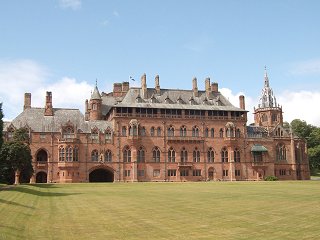
A marvellous, if perhaps over-powering, vision of 'Scottish Gothic' by one of the masters of this style, Sir Robert Rowand Anderson (1834 - 1921), Mount Stuart lies within parkland on the east coast of the Isle of Bute, 4 miles (6 km) SSE of Rothesay, opposite Great Cumbrae Island. The house, which is the seat of the Stuarts of Bute, was originally built by Alexander McGill (1716), remodelled by George Paterson (1780) and completely rebuilt by Rowand Anderson between 1879 and 1903, following a fire. No expense was spared and the result must be one of the architect's finest creations, with the external appearance of a Venetian palace in red sandstone. The cost was astronomical for the time, said to have reached £600,000 (the equivalent of over £50 million today), then the most expensive house in Scotland. Even more remarkably, what we see today represents only the northern wing of what was once intended. A glass-domed ballroom was planned to link this to an equally-enormous southern wing.
The cathedral-like interior, together with the touches of the occult in the Horoscope bedroom with its Egyptian-influenced furniture, undoubtedly reflect the complex character of the sponsor of the work, John Crichton-Stuart, the 3rd Marquess of Bute (1847 - 1900). Bute's great wealth allowed him to pursue a range of interests and he was also a deeply religious man who had converted to Catholicism in 1868. The building of Mount Stuart and his other fantasies of Cardiff Castle and Castell Coch in South Wales reflect his interests in religion, astrology, mysticism and Mediaeval times. They may also reflect a desire to escape the hard realities of coal-mining and the other business interests which generated his vast wealth.
While the 3rd Marquess delighted in the work, changing tastes in the 20th C. meant the 4th Marquess, who otherwise was a great conservationist of the built environment, is said to have wished the house demolished, although he continued to live there. It went on to serve as a Royal Naval Hospital during the First World War, under the careful eye of his wife, Lady Augusta Bute.
Unique features of the house include the magnificent hall, incorporating contrasting marble of the finest quality and lit through beautiful stained glass, the chapel in white marble, detailed carved and painted ceilings in many rooms and a vaulted Gothic swimming pool in the basement. This was the first heated indoor pool in Britain and the house was designed with central heating, electric lighting, a passenger lift and a telephone system, all firsts for a home in Scotland. Bronze railings around the gallery are copies of those seen at the tomb of the Emperor Charlemagne at Aachen. The 18th C. chimney-pieces in the Dining Room were probably rescued from the original Georgian house. There is much evidence of work having stopped before completion; the ceiling in the library remains unpainted and several marble carvings around the Great Staircase are either incomplete or remain as rough-hewn blocks.
The house also incorporates a fine collection of 17th and 18th C. furniture and paintings acquired by John Stuart, British Prime Minister and the 3rd Earl of Bute (1713 - 92), together with silverware brought from Dumfries House and a substantial library, distributed over several rooms, with more than 25,000 books.
The fine gardens were principally designed by the English landscape architect Thomas Mawson in the late 1890s and include the 2-ha / 5-acre Wee Garden, with exotic plants from Latin America and Australasia, and the Calvary Walk with a series of pools and magnificent cascades intended to replicate the Via Dolorosa, along which Christ walked to his crucifixion. There is also a rock garden, a kitchen garden and Victorian and New Pinetums, which preserve many fine trees and rare species in collaboration with the Royal Botanical Garden Edinburgh.
More information is available...