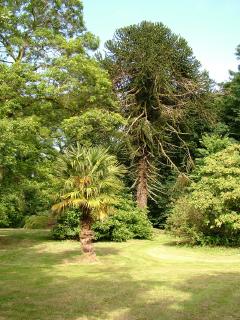
Located next to Galloway House in the Machars of Dumfries and Galloway, Galloway House Gardens comprises woodland and walled gardens first laid out next to his new house by the Alexander Stewart, 6th Earl of Galloway (c.1694 - 1773), in the mid-1740s. Successive Earls developed the house, gardens and surrounding parkland planting an enormous number of trees, creating features such as hahas and adding exotic species collected from around the world.
The mild climate brought great success. Visitors can walk through majestic trees, past rhododendrons, azaleas and flowering shrubs, on to the ruins of the 13th-century Cruggleton Castle and the quiet seashore of Rigg Bay. The garden is particularly noted for its spring display, with at least twenty varieties of snowdrop, followed by daffodils and later bluebells. Also found here is a rare example of a Handkerchief Tree (Davidia involucrata).
Captain Neil McEacharn (1884 - 1964), whose father had bought the house and estate in 1908, learned to garden here and was responsible for much of the modern layout and exotic planting. He later moved to Italy where he created the world-famous gardens at the Villa Taranto overlooking Lake Maggiore. When he sold Galloway House to fund his Italian venture, it was bought by Lady Forteviot, the widow of whisky baron John Dewar (1856 - 1929). Her step-grandson, Edward Strutt, was responsible for the fine rhododendron collection and, in 1987, created a charitable trust to ensure the future preservation of the gardens.