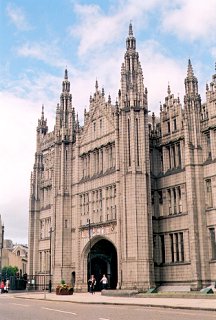
A former university building situated on Broad Street in Aberdeen, Marischal College now forms the headquarters for Aberdeen City Council. Opened on 21st June 2011, the A-listed building comprises 16,165 sq. m (174,000 sq. feet) of office space over four floors and houses 1300 staff. It represents the second largest granite building in the world, next to El Escorial Palace in Spain.
Founded in 1593 by George Keith, 5th Earl Marischal of Scotland (c.1553 - 1623), Marischal College was created as a Protestant alternative to King's College in Old Aberdeen, with the aim of training post-Reformation clergy. Architect Archibald Simpson (1790 - 1847) was responsible for a new Tudoresque quadrangle in 1837. The Gothic-style tower was extended to its present height of 85m (279 feet) during a rebuilding scheme of 1891-95 by A. Marshall Mackenzie (1848 - 1933) and a remarkable granite facade was added in 1906. This facade represented a considerable technical achievement, with fine details achieved after steam technology allowed for more sophisticated granite cutting techniques than had previously been thought possible.
By the early 21st century, much of the University of Aberdeen's teaching and research had gravitated to other sites and Marischal College was greatly underused. In 2006 it was announced that the majority of the building would become the new Council headquarters having been acquired from the University on a 175-year lease, for which the Council paid the remarkably modest sum of £4.7 million. A £65-million refurbishment commenced shortly thereafter which completely rebuilt the structure within the existing walls and added a new extension to the north. The building is partially heated by a biomass boiler.
Marischal Museum has a collection of national significance, with displays including Egyptian and Classical antiquities, Scottish prehistory and the heritage of northeast Scotland, together with temporary exhibitions. This is still owned and managed by the University. Also retained by the University is the Mitchell Hall, once used for graduation ceremonies, which was named in honour of Charles Mitchell (1820-95), an Aberdonian and alumnus of the University who made his fortune building ships on Tyneside. A large stained-glass window which dominates this hall portrays the University's history and was the work of Mitchell's friend T.R. Spence.