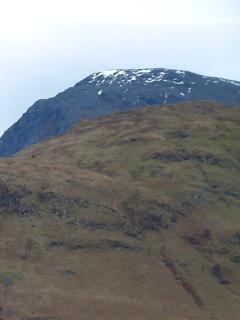
A granite mountain rising to a height of 1345m (4411 feet) to the east of Fort William in Lochaber, Ben Nevis is the highest peak not only in Scotland but in Great Britain. In association with Carn Mor Dearg to the northeast it forms a vast northwest-facing horseshoe. The northeast face of the mountain is possibly the most interesting with a grand array of cliffs composed of tough rocks that are suitable for climbing. The Tower and Castle Ridges and the imposing North-East Buttress are also popular with summer climbers. The 2-mile (3-km) long 610-m (2000-foot) high headwall is the most formidable rock face in Britain and provides the most challenging ice and snow climbing in the country.
Its summit is marked by an Ordnance Survey primary triangulation pillar. The surveyed height of the mountain as shown on the Ordnance Survey map of 1902 was 4406.3 feet (1343m). It was resurveyed in 1949 and found to be 1344m (4409 feet) but further re-measurement in 2016 using high accuracy GPS equipment brought a another revision upwards to 1344.527m (4411.18 feet), which was rounded to 1345m - now quoted as the official height.
On the northeast ridge of Ben Nevis stand the ruins of a weather observatory that was manned between 1883 and 1904. A pony track was created to provide access to the observatory where Nobel prize-winning physicist Charles Wilson (1869 - 1959) developed his ideas for the cloud chamber which made the tracks of ionising particles - atoms - visible. William Speirs Bruce (1867 - 1921), leader of the Scottish National Antarctic Expedition (1902-04) worked in the observatory and learned to ski here. For a while the observatory operated as a temperance hotel and in 1911 a Model T Ford was driven to the summit.
Ben Nevis became popular with tourists following the opening of the West Highland Railway to Fort William in 1894 and in the following year the first Ben Nevis Hill Race was run from foot to summit and back again. This event now takes place each year in September with the record time being 1 hour 25 minutes. The West Highland Way proceeds through Glen Nevis to the west, which is where the 'tourist path' up the mountain begins, a strenuous walk that takes between three-and-a-half and five hours to the top depending on fitness. The first recorded ascent of Ben Nevis was in 1771 by the botanist James Robertson and other early ascents were made by the African explorer Mungo Park and the poet John Keats (1818). In 2000 the mountain was acquired by the John Muir Trust. An international Peace Cairn was erected on Ben Nevis by Bert Bissell from Dudley who made his 104th ascent of the mountain on his 90th birthday in 1992. The peak is now said to be climbed by more than 125,000 people each year. One of the more unusual ascents took place in 2018, when Ginge Fullen and his team made it to the top in a historical diving suit having started at the bottom of Loch Linnhe. In 2008, after two years of preparation, David MacLeod (b. 1978) climbed and named Echo Wall on the south face of Ben Nevis. This is said to be the most challenging ascent in the UK and one of the most difficult in the world.
A 4.5m (15 foot) diameter tunnel associated with the Lochaber Hydro-Electric Power Scheme, supporting the Lochaber Aluminium Smelter, cuts through the northern slopes of the mountain, emerging at a height of 185m (607 feet) above Fort William.