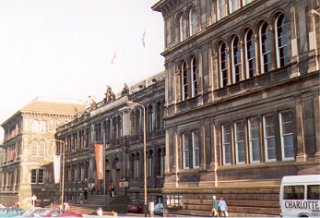
Forming the major part of the National Museums Scotland, the Royal Museum is located in Chambers Street in central Edinburgh and is Scotland's busiest tourist attraction with around 2.2 million visitors in 2019. This A-listed Victorian building was designed by Captain Francis Fowke, of the Royal Engineers. Externally the building exhibits Venetian Renaissance style, while the main hall develops the open architectural style developed by Sir Joseph Paxton for the Crystal Palace in London.
The thirty-six galleries include the natural world and geology, art, design and fashion, science and technology, world cultures, and social and technological history. Notable exhibits include a lofty Tyrannosaurus rex; Scottish wildcats; Scottish minerals - including Macphersonite discovered and named after one of its own staff in 1984; the Millennium Clock, which strikes regularly through the day; the oldest surviving colour television; the story of Scottish lighthouses; Emperor Napoleon's tea service; religious art and numerous objects from Ancient Egypt.
In 1998, the Royal Museum was united with the National Museum of Antiquities, which had previously been in Queen Street. The museum building was significantly extended in 1999, to create a Museum of Scotland, devoted to the history and culture of the country. Since 2006, the Royal Museum and the Museum of Scotland have together been known as the National Museum of Scotland. The original building re-opened in 2011 following a three-year refurbishment at the cost of £47.4 million. More than 20,000 objects are now on display and the museum received almost 1.6 million visitors in 2015, making it Scotland's most popular tourist attraction. A further building refurbishment brought ten new galleries in 2016.
Originally the Museum of Science and Art, it was built to house the University of Edinburgh's natural history collections, which had previously been located in Old College. In 1854, Parliament authorised funds for the new museum and the foundation stone was laid by Prince Albert in 1861, his last public duty before his early death. The building proceeded in a series of phases, which were not all completed until 1888.
Opened in 1866, relations between the University and the new museum deteriorated quickly due to the constant borrowing of specimens for teaching and their occasional loss. The limited care and attention paid to the collection by the University came to a head when Professor Charles Wyville Thomson (1830-82), who was the responsible curator, left on the Challenger Expedition. Consequently, the museum went ahead and appointed its own curators, and symbolically the bridge, which can still be seen today linking the two institutions across West College Street, was permanently sealed.
The National Museum of Scotland also includes the Museum of Flight in East Lothian, the National War Museum of Scotland in Edinburgh Castle, the Shambellie House Museum of Costume, in Dumfries & Galloway, and the National Museum of Rural Life in East Kilbride, which is a partnership with the National Trust for Scotland. The National Museums Collection Centre is a storage and research facility in Granton in Edinburgh.