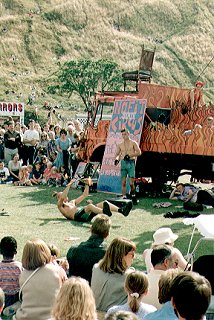
A remarkable area of parkland in the centre of Edinburgh, Holyrood Park extends to 260 ha (650 acres) next to the Palace of Holyroodhouse, to the southeast of the Old Town. Known also as the Queen's Park, because it is still owned by the monarch, it is almost always open for the public to enjoy. Although entirely surrounded by the city, the park offers solitude and stimulating walking. Between locals and tourists, the park can receive upwards of 5 million visitors annually. It represents a nationally-valued resource for the study of geology and archaeology. Hutton's Section, on Salisbury Crags, is of international importance to geologists. In addition, the park represents an important greenspace that defines the character of the city, on the edge of the Old and New Towns World Heritage Site.
The park contains Arthur's Seat, the remains of an ancient volcano, together with the dramatic Salisbury Crags and three lochs, the largest of which is Duddingston Loch, a bird sanctuary, together with Dunsapie Loch and St. Margaret's Loch. Only Duddingston Loch is natural; the others were artificially-created in the middle of the 19th century.
Originally a royal hunting estate, it became a place for those seeking sanctuary from criminal acts by the 14th century and was enclosed by a stone wall built on the instructions of King James V in 1541. King Charles I appointed Sir James Hamilton of Prestonfield House and his heirs as Hereditary Keepers of the Park. Direct control by the monarch was re-established 200 years later and a plan drawn up by Prince Albert, Consort to Queen Victoria, to make the park more accessible, which also included laying out the Queen's Drive. Today there are five road entrances to the park, two at Holyrood, and one each at Duddingston, St. Leonards and Meadowbank. The four original entrances are guarded by a lodge, which were also part of Albert's scheme.
The park also contains evidence of several Iron-Age forts and farm-steads, together with well-preserved cultivation terraces, and St. Anthony's Chapel and Well. In 1832, the Holyrood Park was seriously considered as the site of a grand garden-cemetery, although this was thankfully never built. Firing ranges were constructed by the military in Hunter's Bog the mid-19th century. On the night of the 2nd April 1916, a German Zeppelin airship dropped the remainder of its bombs in the Park when it was attacked following the only air-raid on Edinburgh during the First World War.
Dolerite (or whinstone) was quarried from Salisbury Crags as setts for Edinburgh's cobbled streets, while sandstone was extracted from the park to be used to build houses. Trace fossils, together with ancient ripple-marks and preserved mud-cracks can be found in the Camstone Quarry to the rear of Salisbury Crags.
The complex geology of the park has led to rich and diverse plant communities, with over 350 plant species being recorded, including a number of species that are rare in Scotland. Duddingston Loch supports a number of breeding waterfowl. Sheep grazed in the part until they were removed in 1977, partially for their own safety due to increased use by the public and dog-walkers, but also to reduce environmental damage. The entire park is now protected as a Scheduled Ancient Monument and Site of Special Scientific Interest. However it remains the focus for national events, formal sporting events and many forms of informal recreation.