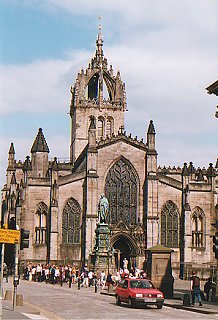
St. Giles' Kirk (or Cathedral) dates from 1120, and is located on Edinburgh's Royal Mile, at the front of Parliament Square. Built by King Alexander I (1077 - 1124), St. Giles is still regularly visited by royalty. Its crown-shaped spire, which was added in 1495, is a notable feature of the Edinburgh skyline.
In the strict sense, St. Giles in not a cathedral because it has never been the seat of a Bishop, other than for two brief periods in the 17th C. (there is no hierarchy in the Scottish Presbyterian system). However, it does represent a national place of worship for Scotland and is regarded by many as the 'Mother Church' of Presbyterianism. St. Giles was at the centre of the Protestant Reformation in Scotland, with John Knox (c.1513-72) becoming minister in 1559 and the building was later divided into separate churches. A bronze statue of Knox stands in the north aisle, the work of sculptor Pittendrigh MacGillivray in 1904. The Anglicisation of the Kirk under King Charles I (1600-49) gave rise to the incident whereby Jenny Geddes (1600-60) is alleged to have thrown a stool at the Bishop (1637), but the National Covenant, signed at the nearby Greyfriars Kirk in 1638, marked a return to the Scottish Presbyterian system. However, James Graham, 1st Marquis of Montrose (1612-50) who helped frame the National Covenant, was hanged at the Mercat Cross behind St. Giles and later buried in the Kirk (1661). In 2022, Queen Elizabeth II lay in state here for a day following her death at Balmoral Castle. The Kirk also contains memorials to Robert Burns (1759-96) and Robert Louis Stevenson (1850-94).
The building has been subject to much remodelling over the years, more recently in 1872-83 financed by William Chambers (1800-83), which reunited the interior as a single space, and a £6.2 million refurbishment 1995 - 2011, which ensured the building was structurally sound and brought new lighting to the interior. Today, St. Giles is notable for its fine stained glass, the Thistle Chapel and its magnificent modern organ.
The Thistle Chapel (1911, by Robert Lorimer) is the chapel of The Most Ancient and Most Noble Order of the Thistle, Scotland's foremost Order of Chivalry. It is a small, but exquisite, chapel with carved and painted fittings of extraordinary detail. The Order, which was founded by James VII in 1687, consists of the monarch and 16 knights. The knights are the personal appointment of the crown, and are normally Scots who have made a significant contribution to national or international affairs. Knights have included Sir Alec Douglas-Home, Lord Mackay of Clashfern and the Duke of Buccleuch.
Widely recognised as being one of the finest in Europe, the organ is by the Austrian company of Reiger Orgelbau. It was installed in the Southern Transept in 1992, replacing a Harrison and Harrison instrument which was in poor condition. It was gifted by Alistair Salvesen, of the Leith shipping family. St. Giles is noted for its music with a good choir, together with lunchtime and Sunday-evening concerts which provide a stage for performers from around the world.