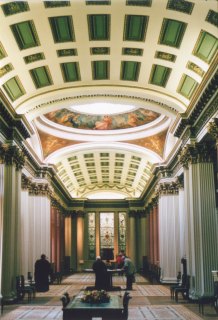
Lying alongside Parliament House occupying the western section of the frontage on Parliament Square is the Signet Library. This comprises the grandiose Upper Library, Lower Library and West Wing. The Upper Library, to a design by Robert Reid (1774 - 1856) with interiors by William Stark, was completed in 1822. It was originally built as a library for the Advocates of Edinburgh, but William Burn (1789 - 1870) made alterations in 1833 when the library came into the possession of the Writers to the Signet.
Inside, the Upper Library consists of a main 'nave', featuring Corinthian columns, with bays containing the books and half way down a 'transept'. Above the crossing is coffered saucer dome which is spectacularly decorated with a vision of Apollo and the Muses, historians, philosophers and poets, by Thomas Stothard (1821). George IV, who saw the library in the year it was completed, is said to have described it as the most beautiful room he had ever seen. This room is in many ways similar to Playfair's Upper Library in the Old College of the University of Edinburgh, which was completed just slightly later but on a larger scale, although the Signet Library is more luxuriantly decorated, furnished and maintained. (Reid's frontage along Parliament Square is also closely modelled on Robert Adam's earlier work on Old College). Unlike the University's room, the Signet Library is still replete with books, including many ancient and valuable volumes.
The Upper and Lower libraries are linked by a grand staircase by Burn, with a screen dating from 1819 by William Playfair (1789 - 1857). The Lower Library is divided into reading bays, each with its own dome.
The west wing by Sydney Mitchell (1903), was originally used for storage, but has been carefully redeveloped to provide more accommodation by Benjamin Tindall Architects (1995).