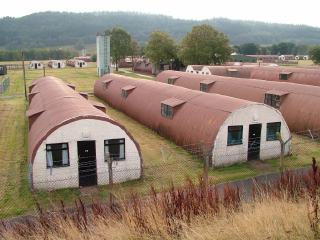
A location and community project at the entrance to Glen Artney in Perth and Kinross, Cultybraggan lies 2 miles (3 km) south of Comrie by the Water of Ruchill. Latterly serving as a military training establishment, Cultybraggan Camp was built in 1939 and housed up to 4000 German prisoners during the Second World War, many of whom were the toughest Afrika Korps and SS troops. Five of the prisoners were tried, and eventually hanged at Pentonville Prison in London, after murdering a fellow prisoner whose zeal for the Nazi cause had, in their view, waned in captivity. Nazi leader Rudolph Hess was held here for a night en route to England after crash-landing in Scotland.
The numerous nissen huts which comprise the 3.2-ha (8 acre) camp have changed little since their construction. Cultybraggan represents the most complete prisoner-of-war camp remaining in the UK and is now listed for its historical importance. The camp lies close to the site of a much earlier Roman fort which guarded the mouth of the glen. Adjacent training and firing ranges at Tighnablair, which extend to 4860 ha (12,000 acres), were leased from the Drummond Estates after the war.
In 1990, a Regional Government headquarters bunker was briefly established here following the closure of the centre at Troy Wood (Anstruther). Almost as soon as it was completed this two-storey £3.6 million underground structure had outlived its usefulness, although it was subsequently used to provide classrooms and other facilities for military training.
The camp and 36.4 ha (90 acres) of surrounding land was bought by the community in 2007 under the provisions of the Land Reform (Scotland) Act and is now run by the Comrie Development Trust. Several buildings have been let as small commercial enterprises, community allotments were created and a visitor centre opened in 2014. A community orchard was planted in 2010 and sports facilities are being developed. The Regional Government bunker was sold by the Development Trust in 2014 and will become a commercial information technology data centre. The £150,000 raised was used to pay off the loans taken on to facilitate the community buy-out.