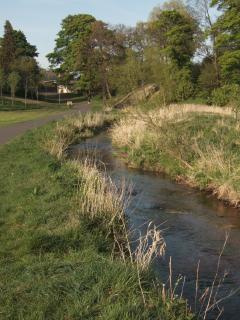
Formed by the meeting of headwaters which rise in the Pentland Hills, the Braid Burn collects the waters of the Bonaly Burn and Howden Burn and flows for 9 miles (14 km) northeast through the City of Edinburgh. It becomes the Figgate Burn northeast of Duddingston and completes its final mile (1.5 km) to drain into the Firth of Forth at Portobello. The Braid Burn flows to the south of Colinton, then on through Firrhill and Greenbank, through the picturesque Hermitage of Braid between the Braid Hills and Blackford Hill, and past Liberton and Cameron Toll. Here, at what was once the Cameron Myre, the burn was culverted yet caused severe flooding within Cameron Toll Shopping Centre not long after it opened in the 1980s. The Braid Burn then follows a sluggish course through Inch Park and passes Cameron Toll Lade, before receiving the Pow Burn and dividing the University of Edinburgh playing fields at Peffermill. It next meets the outflow from Duddingston Loch, where it turns north before becoming the Figgate Burn at Duddingston Mills. In 1882, the Edinburgh city fathers were forced to take legal action to prevent pollution entering the burn, which had acted as an open sewer, particularly from the heavily polluted Pow Burn, that once followed a slightly different course before joining the Braid Burn.
Following floods in 2000 and 2002, a major flood alleviation scheme was initiated along much of the length of the Braid Burn in 2004 at a cost of £43 million. This involved building walls, embankments, restoring the river to a more natural meandering course, creating wetlands to capture excess water and constructing temporary flood storage reservoirs which make use of Inch Park and Peffermill playing fields.