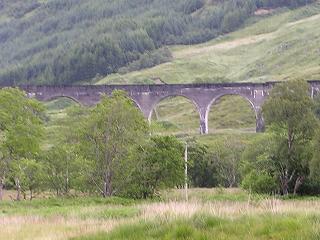
A spectacular engineering construction which curves across Glen Finnan 13 miles (21 km) west northwest of Fort William, the Glenfinnan Viaduct carries the West Highland Railway over the River Finnan on its way north to Mallaig. The structure comprises twenty-one semi-circular arches and was the first viaduct in the world to be fabricated solely from concrete, an unusual material for the time. It was built between 1897-98 by Sir Robert McAlpine (known as 'Concrete Bob'), under the engineering supervision of Simpson & Wilson of Glasgow. The viaduct is 380m (1248 feet) in length, reaches 30.5m (100 feet) in height, curves on a 201m (660 feet) radius and cost of £18,904.
During World War II, the viaduct was regularly 'blown up' in exercises by Special Operations Executive agents, who trained in acts of sabotage in this area before being sent into occupied Europe. A plaque celebrating the centenary of the viaduct was unveiled on the 12th July 1997 by Sir William McAlpine, now head of the family construction firm founded by his great-grandfather. The viaduct has become known internationally as a location for several films, most notably on the route of Hogwarts' Express in the Harry Potter films The Chamber of Secrets (2002), The Prisoner of Azkaban (2004) and The Goblet of Fire (2005). It has also appeared in Ring of Bright Water (1969), based on the Gavin Maxwell novel, the war-film Charlotte Gray (2001), the comedy-adventure Around the World in 80 Days (2004) and the computer game Forza Horizon 4 (2018). Its image has also appeared on £10 banknotes first issued by the Bank of Scotland in 2007.
Glenfinnan Station lies a half-mile (1 km) to the west.