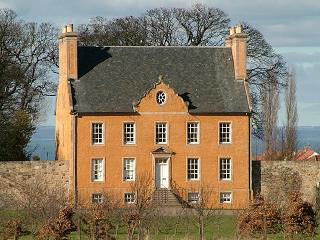
Located immediately to the south of Prestonpans in East Lothian, is Bankton House, separated from the town by the railway. This 17th Century mansion takes the form of a central block with two pavilions, lying to the east and west, all decorated in distinctive orange lime harling. The western pavilion once incorporated a doo'cot and now contains a small exhibition recording the history and restoration of the house.
The original building was erected in the late 12th century and was associated with the monks of Newbattle Abbey, who had been granted charters to much of the surrounding area. It became known as Holy Stop (later Oliestob). The property passed through the hands of Mark Ker, Earl of Lothian (1553 - 1609), Sir Alexander Morison of Prestongrange (who purchased it in 1632) and the Setons of Winton and, through marriage, to the Hamilton family. It was also occupied by lawyer Sir Hew Dalrymple (1690 - 1755) for a time. Around 1742, the house and estate were sold to the celebrated Col. James Gardiner (1687 - 1745), who died nearby at the Battle of Prestonpans. Thereafter the house was bought by an Edinburgh advocate, Andrew McDouall (1685 - 1760), who took the title Lord Bankton when he was promoted to the bench. This name then became attached to the house.
Adjacent, to the east, was the site of the former Bankton Colliery and the house was acquired by the government-owned Coal Board. Having become a roofless shell, the house was restored and converted into flats by the Lothian Building Preservation Trust and Nicholas Groves-Raines Architects between 1988 and 1995, with grants from Historic Scotland, the European Regional Development Fund, East Lothian District Council and Scottish Natural Heritage. The project won a Saltire Award in 1995. An old orchard was replanted on the north side of the house at this time. This includes numerous varieties of apples, pears, plums, quinces, medlars, gages and damsons.