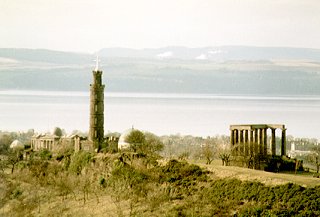
Rising to 108m (355 feet) to the east end of Princes Street in the centre of Edinburgh, Calton Hill is not the highest of the city's hills, yet it occupies a dramatic setting with dramatic views to Leith, the Firth of Forth and Fife to the north and Holyrood Park to the south. Remarkable too for its eclectic assortment of architecture, Calton Hill is largely responsible for Edinburgh's soubriquet as The Athens of the North. Geologically the hill is volcanic in origin, dating from the Lower Carboniferous age (335 million years ago), similar to Arthur's Seat and Castle Rock. Calton Hill is composed of lava and is thought to represent part of the cone of the Arthur's Seat volcano, later displaced by geological faults and sculpted into a distinctive crag-and-tail by ice. The hill now forms part of a Site of Special Scientific Interest (SSSI).
Buildings and monuments of note include the Nelson Monument (1816), built in the shape of a telescope; the unfinished National Monument (1822), modelled on the Parthenon but otherwise known as 'Edinburgh's disgrace'; the City Observatory, comprising Observatory House (1776), the Old Observatory (1818) and the City Dome (1895) and monuments to philosopher Dugald Stewart (1753 - 1828) and mathematician John Playfair (1748 - 1819), both designed by William Playfair (1789 - 1857). There is also an interesting monument commemorating the success of the vigil for the return of the Scottish Parliament, built in 1998.
Around the waist of Calton Hill lies Regent Road, the eastward extension of Waterloo Place. Notable buildings on Regent Road include St. Andrew's House, the home of government in Scotland and the Old Royal High School, once intended as the site of the Scottish Parliament. There are also Regent, Calton and Royal Terraces, notable for their desirable town-houses, one of which is occupied by the United States Consulate, with others having been the homes of the artistocracy and other notables. Calton Road runs along the base of the hill, to the south, separating Waverley Station from cliffs known as Calton Craigs. London Road and the Hillside development lie to the north, the western section was developed 1823-25 to designs by William Playfair, but the remainder not executed until the 1880s.