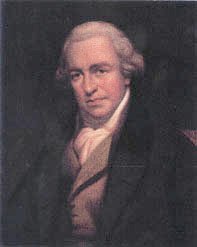
Inventor and engineer. Born in Greenock, James Watt learned the trade of a mathematical instrument maker in Glasgow before setting up a business in London. He was employed on surveys of the Forth and Clyde Canal (1767) as well as the Caledonian Canal and the improvement of harbours.
After repairing a model of a Newcomen steam engine belonging to the University of Glasgow, Watt realised he could improve on that simple design. He thus developed the steam engine into a practical source of power, patenting various new versions. He invented the governor as a control device, and also the flywheel. He entered a partnership with Matthew Bolton to build engines on a commercial basis at Birmingham (1774).
He also coined the term 'horsepower' and another unit of power, the watt, was named in his honour. He was awarded an honorary degree by the University of Glasgow.
He died at Handsworth Wood (Birmingham) and lies buried in the nearby St. Mary's Church, within the James Watt Memorial Chapel, where there is also a fine statue of Watt by Francis Chantrey (1781 - 1841).