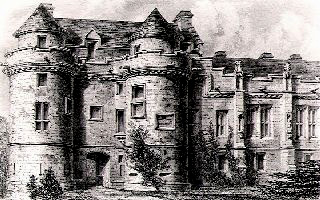
Dominating the historic village of Falkland, the palace was originally built as a residence for King James IV in 1500, replacing an earlier 12th-century castle. It is a fortified but comfortable Renaissance-style residence, and comprised ranges of buildings around an open courtyard. The south gatehouse range survives complete, while the east range is ruined, and only traces remain of the north range, which burned during Cromwell's occupation (1652).
The Chapel Royal, includes fine mullioned windows, a 16th-century oak screen and a beautifully painted ceiling which dates from 1633. There is also a gallery displaying fine tapestries. The Cross (or Croce) House contains the restored royal bed-chamber, where King James V died in 1542. Adjacent to the palace is a garden, within which there is a Royal Tennis Court dating from 1539. This is one of only two in the United Kingdom, the other being at Hampton Court.
Mary, Queen of Scots and King James VI visited the palace, but royal patronage was not sustained after the Union of the Crowns in 1603. King Charles I visited in 1633, and King Charles II in 1650-1. However, despite a visit by King George IV (1822), the palace deteriorated until 1887 when it was restored by the Marquis of Bute. The palace still belongs to the Queen but has been maintained since 1952 by the National Trust for Scotland in its role as Deputy Keeper.