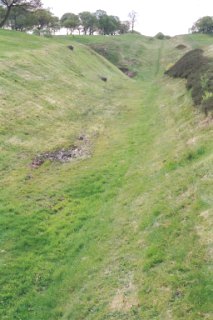
A Roman defensive fortification between the Forth and Clyde in Central Scotland, Antonine's Wall was built in honour of Emperor Antoninus Pius by Lollius Urbicus, the Governor of Britain, around 143 AD. It established a frontier to the north of Hadrian's Wall in England, with the intention of restraining the Pictish tribes to the north and as such represents the North-Western boundary of the Roman Empire. However, residual hostile tribes in the Southern Uplands of Scotland forced more than one retreat to the safety of Hadrian's Wall, and the Antonine Wall was probably completely abandoned by 180 AD.
The wall is 37 miles (60 km) in length, running from Bo'ness to Old Kilpatrick, but is best observed to the southwest of Falkirk.
Unlike Hadrian's Wall, which is built of stone, the Antonine Wall was constructed of turf on a loose boulder foundation and most-likely topped with a wooden rampart. In front of the wall, on its north side, was a 3.6m (12-foot) deep ditch. To the south of the wall was a cobbled roadway, known as the 'Military Way', that connected the network of forts which lay approximately every 2 miles (3 km) along the wall to provide accommodation for its garrison. It is thought the wall may have required a complement of around 30,000 men to maintain the defence.
Nominated in 2003, the wall was accepted by UNESCO as a World Heritage Site in 2008.