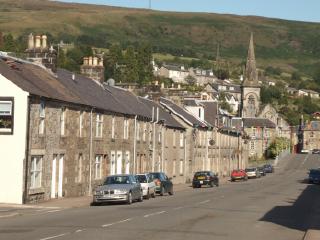
The burgh of Langholm in Dumfries and Galloway is located at the confluence of the River Esk and Ewes Water, 30 miles (48 km) east of Dumfries. Known as the 'Muckle Toon', James II defeated the Douglases here in 1455 and a burgh was created in 1621. The grid-iron pattern on the west side of the Esk was laid out in 1778 when the Duke of Buccleuch founded the 'New Town' of New Langholm. The town became a regional wool centre with several mills in production from the mid 19th Century onwards. Its industries have also included cotton manufacture, brewing and distilling.
Notable buildings include the library (1875-8), the Town Hall (1811-12), the ruins of Langholm Castle (16th century, a half-mile / 1 km north), the mansion house of Langholm Lodge (1786-9, by James Playfair, a half-mile / 1 km northwest), as well as the Mercat Cross (c. early 17th century), and the Boatford Bridge (c.1871). Langholm once had a railway station and a monument commemorates the last train on 13th June 1964. The site has subsequently been redeveloped for housing.
Born here were poets William Julius Mickle (1734-88) and Hugh MacDiarmid (C.M. Grieve; 1892 - 1978). The former is remembered by a fountain in the town, while the latter is celebrated with a memorial of an open book and a cairn on the north flank of Whita Hill (1¼ miles / 2 km to the northeast). This hill is surmounted by an obelisk commemorating General Sir John Malcolm (1769 - 1833), while his brother Admiral Sir Pulteney Malcolm (1768 - 1838), also born here, has a statue in the town. Astronaut Neil Armstrong was made a Freeman of the Burgh in 1972.
A Common Riding takes place annual at the end of July, led by a young man known as the Coronet, traditionally associated with the protection of the town's land. This includes the curious tradition of nailing a salted herring to a barley bannock.