Linlithgow is situated on the right bank of the
River Avon, on the northwestern boundary of
West Lothian between the
Bathgate Hills in the south and the
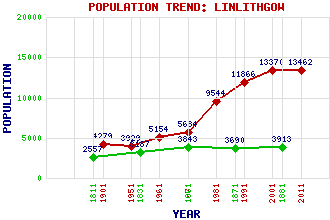
Airngath Hills to the north. Its population has grown rapidly with its popularity as a dormitory town, rising from just 5684 in 1971 to 13370 in 2001.
Linlithgow Loch, lying to the north of the town, served as a defence but also provided water for the town and for its tanning industry. Geologically, the town is underlain by basalt lavas erupted from Carboniferous volcanoes around 320 million years ago.
The name Linlithgow seems to originate from the Brythonic (British) words 'llyn' meaning 'lake', 'lleith' meaning 'moist' and 'cau' meaning 'hollow', thus representing the 'place by the lake in the moist hollow'. The town developed from Linlithgow Palace in both directions along the High Street, with the Mediaeval riggs still evident in the long narrow gardens which lies behind the houses. By the 19th C. substantial villas were developed on the slopes of the Bathgate Hills to the south of the town centre, beyond both the canal and railway. Rapid development took place in the 20th C., first involving public housing to the southwest in the 1930s (Preston) and 1950s (Braehead), and then private housing to the east at Baron's Hill and beyond, to the south infilling the policies of Victorian villas and to the west, merging Linlithgow and Linlithgow Bridge.
Linlithgow was a frontier settlement for the Romans, with the northernmost boundary of the Empire terminating at
Bo'ness just 3 miles (5 km) to the north. However, it was King David I (1083 - 1153) who build a royal residence here and is credited with founding the town. A thriving settlement certainly existed when
King Edward I of England (1239 - 1307) visited in 1291. He returned several times during his campaigns in Scotland, ultimately building a fortification here in 1302.
Edward II (1284 - 1327) stayed here in 1310 while
Edward III's army burned the town in 1337. Outbreaks of plague in
Edinburgh saw the Royal Household take refuge in Linlithgow in 1349 and again in the 16th C. The town was devastated by a fire once again in 1411 and then by another just 13 years later.
Linlithgow was represented in the Scottish Parliament from 1366 and two years later it joined the Court of the Four Burghs. The original group included Edinburgh, Stirling, Berwick and Roxburgh, yet the last two were then in English hands requiring others to join. This gave Linlithgow sole rights to the coastal trade along the south shore of the Forth between the River Almond and River Avon, and the town grew rich through customs duties: in 1369 its yields were second only to those of Edinburgh. The town anciently held the port at Blackness, 3½ miles / 5.5 km to the northeast, its possession confirmed by a charter issued by King Robert II in 1389. In 1540, the town gained the right to elect a provost, who presided over a Council that included representatives of the craft guilds and trades; namely the baxters (bakers), coopers (barrel-makers), cordiners (shoemakers), fleshers (butchers), smiths (metalworkers), tailors, weavers and wrights (woodworkers). From a peak in the 17th C., the fortunes of the town declined through the 18th C. as more accessible ports grew at Bo'ness and Grangemouth. In the 19th C., Linlithgow attempted to reassert its trading rights by levying duties on goods transported by rail. The resulting litigation went to the House of Lords and bankrupted the town.
As well as King James V (1512-42) and Mary Queen of Scots (1542-87), other notables born here include James Glen (1701-77), the longest-serving British Governor of South Carolina, Glasgow 'tobacco lord' Stephen Mitchell (1789 - 1874), painters Sir John Watson Gordon (1788 - 1864) and Alexander Fraser (1828-99), oceanographer Sir Charles Wyville Thomson (1830-82), Australian entrepreneur James Hardie (1851 - 1920) and politician Alex Salmond (b.1954). The pioneering lawyer Margaret Kidd (1900-89) was educated at Linlithgow Academy. The memorial (1875) to James Stuart, Regent of Scotland and Earl of Moray (1531 - 1570), who was murdered in Linlithgow, which can be found on the High Street, includes a relief bust by Amelia Paton (1820 - 1904). More unusually, a plaque was unveiled in 2007 to honour Irish-Canadian actor James Doohan, whose character in the epic sci-fi series Star Trek, Chief Engineer Montgomery 'Scotty' Scott, is supposed to have been born here in the year 2222.
Those born in Linlithgow are referred to as 'black bitches', a tradition that comes from the town's arms, which depicts a black bitch (dog) tied to an oak tree. It is said this tree was located on an island in Linlithgow Loch, and that the dog swam across the loch each day to bring food to its master who had been chained to the tree and sentenced to starve to death. When it was discovered what the dog had been doing it met the same fate.
King George V and Queen Mary visited the town in 1914, while Queen Elizabeth II visited in 1955.
Linlithgow Mint made coins for the Scottish Crown between the 14th and 16th C. Other early industries included leather tanning, which continued into the 20th C. and the manufacture of shoes, textiles, soap and glue, together with distilling, brewing, paper-making and calico printing. The
Union Canal opened in 1822 and the railway arrived in 1842, both making the transportation of goods easier. St. Magdalene Distillery was founded in the late 18th century but closed in 1983, with the main building subsequently converted into flats. Their utilitarian bonded warehouse remains on the opposite side of Edinburgh Road, now operated by Morrison Bowmore Ltd. (2014). The Nobel Explosives Company set up the Regent Works in 1908 to make fuses and, later, ammunition but this had closed by the 1970s and was replaced by a shopping centre in 1983.
More recently electronics became an important contribution to the economy, with Racal Thales building a radar factory in the town in 1969 and Sun Microsystems opening their plant nearby in 1990. Thales left in 2003 and Sun ceased manufacturing in 2009, although their plant has been developed as a computer centre after their takeover by software and services multinational Oracle in 2010.
(2000) Historic Linlithgow.
(1989) Linlithgow. Six Hundred Years a Royal Burgh.
(2007) Linlithgow: Pocket Images.
(1984) Linlithgow in old picture poscards.
(1988) Linlithgow Town Guide.
(1978) The Buildings of Scotland: Lothian except Edinburgh.
(2002) Linlithgow Old and New.