Glasgow
Classification and Statistics
|
|
Location
|
Geography
Located on the
River Clyde, Scotland's most populous city lies in the west of the
Midland Valley, 44 miles (71 km) west of
Edinburgh, 34 miles (55 km) northeast of
Ayr and 144 miles (232 km) southwest of
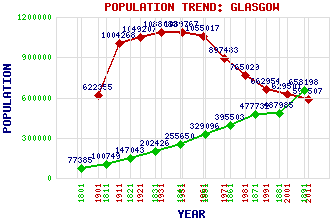
Aberdeen. The area of the city is 175.1 sq. km (43,243 acres), making it the 7th smallest of the 32 local government areas; its population has declined steadily since the 1950s but in 1997 it was still 36% larger than that of
Edinburgh; and it is the third largest regional city in Britain. Its population density remains the highest of any Scottish city, although is around half of what it was in the 1930s. Life expectancy remains the lowest of any city in the UK at 72.6 for males and 78.5 for females (2012). Glasgow was the headquarters of the former county of
Lanarkshire until 1975 when it became the centre of Strathclyde Region (1975-1996).
Glasgow is built on markedly undulating terrain formed by marine deposits and some 180 ice-formed drumlins, most of which are north of the Clyde with their higher sides to the northwest and their 'tails' to the southeast. Its geology also includes large amounts of coal and iron ore. Today much of the area is primarily developed for urban use (77%) with little more than 15% occupying open countryside, the smallest proportion of the 32 councils areas. Glasgow's climate, like much of the west of Scotland, is usually cloudier, slightly warmer and much wetter than the rest of Scotland. It is Scotland's wettest city with 1079mm of rainfall per annum,
The city was extended several times to take in nearby villages and neighbourhoods. The main additions were in 1846 when Anderston, Bridgeton, Calton, Gorbals, Kelvingrove and Woodside were added to the city, in 1891 when Govanhill, Hillhead, Kelvinside, Maryhill and Pollokshields were included and in 1912 when Cathcart, Govan, Partick and Pollokshaws entered the city boundaries. Post-World War Two planning initiatives involved slum clearance and the creation of numerous council-owned high-rise flats on the city's outskirts, the renewal of city-centre housing and the Glasgow Overspill plan which moved several hundred thousand people to nearby New Towns, such as East Kilbride, Cumbernauld and Irvine. Within Glasgow, new public-housing schemes and multi-storey blocks represented a utopian vision for social housing, with inside toilets and central-heating. However, with the highest concentration of social housing in Britain and social problems brought about by unemployment and poor maintenance, these schemes themselves became the problem and demolition of the high-flats in particular became a regular spectacle in the early years of the 21st C.
Glasgow has excellent transport links; once dependent on the river and the Forth & Clyde Canal (opened 1790), Monkland Canal (1793) and Glasgow, Paisley and Johnstone Canal (1810), it now lies at the centre of the Scottish motorway network, with the M8, M73, M74, M77 and M80 all converging around the city. Rail links are provided to the northwest and east from Queen Street Station and to the west and south from the nearby Central Station. Glasgow benefits from the largest suburban rail network in the UK outside London, with at least sixty stations serving the city and its immediate suburbs. There is also an underground, the famous Clockwork Orange (the third-oldest in the world, opened in 1896), which forms a simple loop around the city centre. Public transport in and around Glasgow is coordinated by the Strathclyde Partnership for Transport (SPT), a public body which had its foundations in 1972. Uniquely in Scotland, SPT operates several services itself (principally the underground) as well as coordinating the operations of others by private companies. It also owns and runs Buchanan Street Bus Station (built 1977), the largest bus station in Scotland. Glasgow Airport lies 7 miles (11 km) west of the city centre.
History
Glasgow began as a religious centre with a monastery built by
St. Kentigern (also known as
St. Mungo) in the 6th Century. During the 12th century the town became a burgh (c.1190), gained a cathedral (consecrated 1197) and an archbishopric. It became an educational centre with the founding of the
University of Glasgow in 1451.
The town remained small by Scottish standards; in 1649 it became the country's fourth largest burgh but by 1670 it was the second largest, behind Edinburgh. Its position was ideal for access to Edinburgh, the Highlands, Islands and Ireland, and its wealth grew through a ready supply of natural resources (coal and fish).
Notables born in Glasgow include Virginia Governor Robert Dinwiddie (1693 - 1770), Jacobite Clementina Walkinshaw (1720 - 1802), Agnes Maclehose (Robert Burns' Clarinda; 1759 - 1841), General Sir John Moore (1761 - 1809), Field Marshall Sir Colin Campbell (1792 - 1863), industrialist James Beaumont Neilson (1792 - 1865), shipping magnates Sir George Burns (1795 - 1890) and David MacBrayne (1818 - 1907), social reformer Robert Dale Owen (1801-77), artist Horatio McCulloch (1805-67), naval architect John Scott Russell (1808-82), chemical engineer James 'Paraffin' Young (1811-83), naturalist Thomas Thomson (1817-78), entrepreneur Sir Thomas Lipton (1850 - 1931), engineer Sir Dugald Clerk (1854 - 1932), collector Sir William Burrell (1861 - 1958), actress Mary Gordon (1882 - 1963), playwright James Bridie (1888 - 1951), scientist Lord Todd of Trumpington (1907-97), historical novelist Nigel Tranter (1909 - 2000), industrialist Sir Monty Finniston (1912-91), boxer Benny Lynch (1913-46), actors Molly Weir (1910 - 2004) and Archie Duncan (1914-79), broadcaster Tom Weir (1914 - 2006), comedian Jack Milroy (1915 - 2001), novelist Alistair MacLean (1922-87), baseball player Bobby Thomson (1923 - 2010), actors Gordon Jackson (1923-90) and Russell Hunter (1925 - 2004), entertainers Rikki Fulton (1924 - 2004), Stanley Baxter (b.1926) and Johnnie Beattie (b.1926), politician Winnie Ewing (b.1929), photo-journalist Harry Benson (b.1929), actor Iain Cuthbertson (1930 - 2009), musician Lonnie Donegan (1931 - 2002), producer Sir Jeremy Isaacs (b.1932), actor David McCallum (b.1933), singer Andy Stewart (b.1933), outspoken preacher Most Rev Richard Holloway (b.1933), broadcaster John Dunn (1934 - 2004), author and artist Alasdair Gray (b.1934), politician Donald Dewar (1937 - 2000), adventurer Don Cameron (b.1939), journalist and broadcaster Donald MacCormick (1939 - 2009), film director Bill Forsyth (b.1946), singer Lulu (b.1948), broadcasters Lynn Faulds-Wood (b.1948), Gavin Esler (b.1953) and Sally Magnusson (b.1955), actors Gregor Fisher (b.1953) and Peter Capaldi (b.1958), naturalist George McGavin (b.1954), Simple Minds front-man Jim Kerr (b.1959), television presenters Lorraine Kelly (b.1959), Paul Coia (b.1960) and Carol Smillie (b.1961), artist Ken Currie (b.1960), actor Robert Carlyle (b.1961), singer Jimmy Somerville (b.1961), comedians Jerry Sadowitz (b.1961) and Craig Ferguson (b.1962), golfer Colin Montgomerie (b.1963), satirist Armando Iannucci (b.1964), actors Claire Grogan (b.1962) and John Barrowman (b.1967), comedians Greg Hemphill (b.1970) and Karen Dunbar (b.1971), rower Katherine Grainger (b.1975), actor James McAvoy (b.1979) and swimmer Michael Jamieson (b.1988).
Industry
Glasgow was not suited to European trade but grew during the 17th and 18th centuries through the Atlantic trade (tobacco, cotton, sugar, rum and, to some extent, slaves) and through the rise of manufacturing (e.g., soap-making, distilling, sugar-refining, glass-making and textiles). Textile production used coal in steam-driven cotton mills and power-loom factories; other industries included bleaching, dyeing and fabric printing. The so-called Tobacco Lords grew immensely wealthy after the English colonies in America became accessible to Scotland following the Act of Union in 1707. These men were responsible for some of the city's finest architecture. The available money gave rise to the banking industry and much was lent back to the colonies. Debt, together with price-fixing by the Tobacco Lords, were factors in bringing about the American War of Independence. A slump followed, but Glasgow merchants quickly refocused on trade with the West Indies.
Glasgow grew in the 19th and 20th centuries through textiles, coal, iron, steel, shipbuilding, engineering, chemical works, brewing, distilling, and by making paper, china and glass. Wellpark Brewery was established in 1556 and is now a modern industrial plant operated by Tennent Caledonian. Whisky is still represented by the Edrington Group (Scotland's most profitable privately-held company), Morrison Bowmore and Whyte & Mackay. With a few notable exceptions, much of the city's heavy engineering and shipbuilding closed in the 1960s and 1970s. BAE Systems now runs the Govan and Scotstoun shipyards, building warships, while the Weir Group operates internationally from its Glasgow headquarters, employing 14,000 people in 70 countries. In the 20th C., the headquarters of the Burmah Oil Company and Britoil were in Glasgow, but both were subsequently acquired by BP.
Today, Glasgow benefits primarily from a service economy, with the largest areas of growth in banking, finance and business services; tourism, hotels and restaurants; life sciences; energy and water; and public administration, education, and health. The Clydesdale Bank was founded in Glasgow in 1838 and remains headquartered here. Other areas of strength include retail, telecommunications, software, tourism and media. The arts and creative industries also represent an important part of Glasgow's economy, with both BBC Scotland and STV (Scottish Television) having their headquarters on Pacific Quay. The city has three universities: the University of Glasgow (1451), the University of Strathclyde (1964), and Glasgow Caledonian University (1993). Other public bodies based here include: Scottish Enterprise, Transport Scotland, Sportscotland and Scottish Canals. Glasgow is also home to the Mitchell Library, one of Europe's largest public libraries.
References and Further Reading
Allison, Arthur, at. al. (eds.) (2004) The Glasgow Story.
http://www.theglasgowstory.com/Daiches, David (1977) Glasgow.
Andre Deutsch, LondonDevine, T.M. and Gordon Jackson (eds.) (1995) Glasgow. Vol. I: Beginnings to 1830.
Manchester University PressDoak, A.M. and Andrew McLaren Young (eds.) (1977) Glasgow at a Glance.
Robert Hale Limited, LondonFisher, Joe (1994) The Glasgow Encyclopedia.
Mainstream, EdinburghFraser, W. Hamish and Irene Maver (eds.) (1996) Glasgow. Vol. II: 1830-1912.
Manchester University PressGibb, Andrew (1983) Glasgow. The making of a city.
Croom Helm, LondonLawson, Judith (1981) Building Stones of Glasgow.
Geological Society of GlasgowMacDougall, Carl (1990) Glasgow's Glasgow: The Words and The Stones.
GlasgowMcConnell, Rodger and Stuart Gulliver (1998) Glasgow's Renewed Prosperity. Glasgow's economic position statement.
Glasgow City Council / Glasgow Development AgencyMcKean, Charles, David Walker and Frank Walker (1989) Central Glasgow: An Illustrated Architectural Guide.
The Royal Incorporation of Architects in Scotland, EdinburghPacione, Michael (1995) Glasgow: the socio-spatial development of the city.
Wiley, ChichesterReed, Peter (ed.) (1993) Glasgow: The Forming of the City.
Edinburgh University Press, EdinburghRodger, Johnny (1999) Contemporary Glasgow: The Architecture of the 1990s.
The Rutland Press, EdinburghSmall, Sam (2008) Greater Glasgow: An Illustrated Architectural Guide.
The Royal Incorporation of Architects in Scotland, EdinburghSmart, Aileen (1996) Villages of Glasgow: Volume 2 (South of the Clyde).
John Donald Publishers Ltd., EdinburghSmart, Aileen (2002) Villages of Glasgow: North of the Clyde.
John Donald Publishers Ltd., EdinburghTeggin, Harry, Ian Samuel, Alan Stewart and David Leslie (1988) Glasgow Revealed.
Heritage Books (Scotland) LtdWalker, Frank Arneil (1992) Phaidon Architecture Guide: Glasgow.
Phaidon Press Limited, LondonWilliamson, Elizabeth, Anne Riches and Malcolm Higgs (1990) The Buildings of Scotland: Glasgow.
Penguin, London
| Use the tabs on the right of this page to see other parts of this entry |
 |
Related Entries
There are 1809 related entries.
(191 Attractions,
1 Council Area,
1 Historical County,
19 Events,
4 Families,
513 Features,
7 Parishes,
891 People and
182 Settlements)