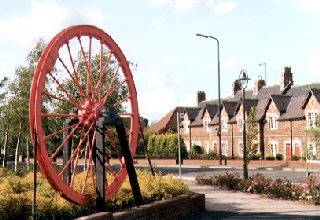
A former mining village in E Midlothian, Newtongrange lies to the east of the River South Esk, 3 miles (5 km) south of Dalkeith. It was developed as a colliery village by the Marquess of Lothian from the 1830s and by the 1890s had become Scotland's largest mining settlement following the sinking of the Lady Victoria Colliery with a shaft of over 530m (1738 feet), the deepest mine in Scotland at the time. The Lady Vic employed 1765 men underground by 1953. The village was also the site of the Lingerwood Colliery, which pre-dated the Lady Vic, and comprised two shafts of 253m (830 feet) and 266m (872 feet) respectively. It employed 770 men at its peak. The two mines were linked below ground and shared overground facilities. Closed in 1981, the principal Lady Victoria Colliery buildings have been preserved and now house the National Mining Museum Scotland.
Newtongrange was laid out in a formal pattern with brick-built houses in parallel streets named First Street to Tenth Street respectively. The housing was segregated by rank within the pit, with simple dwellings centrally-located for the miners themselves, better homes for overseers while managers enjoyed grander residences on the edge of the village. The miners were subject to a series of rules both at home and at work, with the notorious general manager, Mungo Mackay, running both pit and village ruthlessly between 1900 and 1939.
The village regained its railway station in 2015 on the new Borders Railway, its original station having closed with the rest of the Waverley Line in 1969. The ruined 12th-century Cockpen Old Parish Church and 15th-century Dalhousie Castle are located to the southwest.