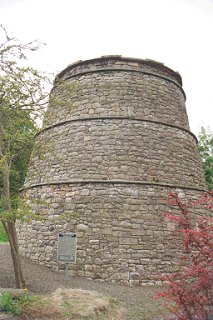
A suburban district of Edinburgh, lying 4 miles (6 km) west of the city centre, Corstorphine was until the 20th Century an agricultural village separated from Edinburgh by open countryside. There were actually two villages: the new or high village developed on St. John's Road along the main route between Edinburgh and Glasgow and the old village, lying a little to the south, which traces its history back to before the 12th Century. A chapel, founded c.1400 by Sir Adam Forrester, became a Collegiate Church, dedicated to St. John the Baptist in 1429, under the patronage of his son Sir John Forrester. Today, much altered, it forms the Parish Church. The 14th Century Corstorphine Castle was dismantled in the 18th Century and now lies in ruins. The only remnant is its 16th Century doocot, surviving in Dovecot Road. The Forrester's mid-17th Century dower house remains on Corstorphine High Street. The character of the old village is maintained by its status as a Conservation Area.
In 1920, Corstorphine was incorporated within the city boundaries and major private housing developments in the inter-war period and between the 1950s and 1980s have made it one of the city's largest suburbs. To the north of the district is Corstorphine Hill, which is the site of Edinburgh Zoo. Opposite the zoo sits Silvan House, the headquarters of Forests Scotland (a successor body to the Forestry Commission), now shared with the Edinburgh office of the government environmental agency NatureScot. Ladywell House, just to the west of the old village, is home to various government agencies including the General Register Office for Scotland. To the southwest is the enormous Gyle Shopping Centre and South Gyle business park. This centre in particular has had a deleterious effect on the local shops. A branch line once took the railway into the heart of the village at Station Road, but this closed in 1969. However the main line runs just to the south, where it splits with services running to Fife and West Lothian.
Corstorphine gives its name to its own unique tree species, the Corstorphine Sycamore (Acer pseudoplatanus Corstorphinense). Its foliage is bright yellow when it first appears, several weeks before most sycamores. The original tree was planted c.1600, forming part of an avenue leading to Corstorphine Castle. At its base, the drunken philanderer James Baillie, 2nd Lord Forrester, was murdered by his lover in 1679. It is also suggested that Lord Forrester buried treasure beneath the tree. This remarkable heritage tree fell in a gale in 1998 and its shattered stump finally died in 2005. A number of artefacts were crafted from its wood, including a violin donated to the Music School at St. Mary's Episcopal Cathedral, while the tree's descendents live on around the city.