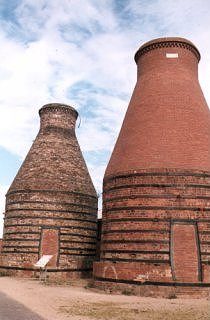
Located just 3 miles (5 km) east of the centre of Edinburgh, this seaside town on the Firth of Forth originated from a single thatched cottage in 1763 held by a veteran of Admiral Vernon's 1739 campaign at Puerto Bello in Panama. Known initially as Figget, the settlement grew rapidly owing to a brick and tile industry which exploited beds of clay beneath the Figgate Burn. A harbour was established in 1788 to export these products. By the end of the century Portobello had become a fashionable bathing resort for Edinburgh's well-to-do. Other industries developed producing bottles, glass, lead, paper, pottery, soap and mustard; an oyster bed was exploited after its discovery in 1839. The town was made a burgh in 1833 and was incorporated into Edinburgh in 1896. By the 1840s the harbour was ruinous and the only reminder today is in the name of the Harbour Green housing development. A pleasure pier opened in 1871, designed by the later notorious Sir Thomas Bouch (1822-80) and featuring a tea room and a concert hall. Having fallen into disuse and damaged by storms it was demolished in 1917. Two bottle kilns, which were built in 1906 and 1909 as part of the A. W. Buchan & Co pottery, remain as a monument to that industry. One partially collapsed while being restored in 2013, but was later rebuilt.
Portobello now serves as a fashionable residential suburb for Edinburgh. Nearby is Joppa which was created in the early 19th century. A popular tourist attraction is the Portobello Promenade, which extends behind a fine sandy beach for 2 miles (3 km) west from Joppa to Seafield.
Notable buildings include the Old Parish Church (1809), the multi-spired St. John's Church (1909) and the villas along Regent Street (early 19th century). The Tower on Beach Lane was built c. 1786 as a summer house using Mediaeval carved stones. A railway station operated on Brunstane Road between 1846 and 1964. The site was redeveloped as a Freightliner Terminal (next to Sir Harry Lauder Road) which operated until the 1980s, although the facility remains intact and the East Coast Main Line railway still passes.
Distinguished residents of the town were geologist Hugh Miller (1802-56), who shot himself at his home on Portobello High Street, physicist Sir David Brewster (1781 - 1868), Antarctic explorer William Speirs Bruce (1867 - 1921) and a young Sir William Russell Flint (1880 - 1969). Music hall artist Sir Harry Lauder was born here in 1870, as was pianist and composer Helen Hopekirk in 1856, and railway engineer James Bell (1844 - 1935). The art impresario Richard Demarco (b. 1930) was raised here. Sir Walter Scott (1771 - 1832) visited the home of his son-in-law and biographer John Gibson Lockhart (1794 -1854) in Bellfield Street. Ian Charleston (1949-90), the actor noted for the film Chariots of Fire was buried in Portobello Cemetery.