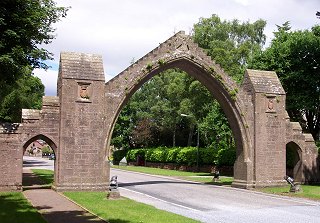
A village and resort between Strathmore and the Howe of the Mearns in Angus, Edzell lies between the Whishop Burn and the River North Esk 6 miles (9.5 km) north of Brechin. The original village of Edzell, which stood near Edzell Castle and the old kirkyard, appears in the written 13th-century records of Arbroath Abbey as Edale or Adele. The present village was previously known as Slateford, describing a crossing over the North Esk River. When the new church was built by Lord Panmure in 1818 Slateford became known as Edzell. The Dalhousie Arch which straddles the road at the entrance to the village was built by tenants of the Dalhousie Estate in 1889 to commemorate the deaths of the Earl and Countess of Dalhousie who had been held in high esteem.
Buildings of historic and architectural interest include the Inglis Memorial Hall which was gifted to the village in 1898 by Colonel Robert Inglis, head of the London Stock Exchange, who had built it in memory of his parents. Bank House in the High Street was originally the British Linen Bank in which James Guthrie, poet and banker, lived and worked. Guthrie, who was appointed by the Union Bank to start a branch in Edzell, took an active interest in the welfare of the village, introducing gas, establishing markets and presiding over the Highland Games.
A suspension bridge known as the Shakkin' Brig was built over the North Esk in 1900 and a golf club was established in 1895. Edzell Muir and Pirner's Brig are favourite picnic spots and walks follow the river from Gannochy Bridge to the Rocks of Solitude.