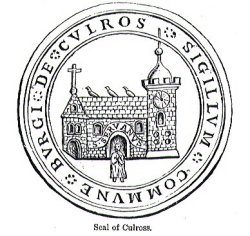
An attractive example of an old Scottish burgh in W Fife, Culross is situated on the River Forth 7 miles (11 km) west of Dunfermline. Created a Burgh of Barony by King James IV in 1484 and a Royal Burgh by James VI in 1588, Culross was the legendary birthplace of St. Kentigern (or St. Mungo). An abbey was founded here in 1217 by Malcolm MacDuff, 7th Earl of Fife (c.1208-66), and coal was first mined by the monks. During the 16th and 17th centuries salt panning, coal mining, weaving and trade with the Low Countries from the foreshore port of Sandhaven were developed, chiefly by the enterprising local merchant Sir George Bruce (c.1550 - 1625). Another famous product of the town at that time was the iron baking girdle, while shoe-making developed in the 18th century. Industry had declined by the end of the 18th century and the population began to fall.
Rising steeply from the shore, the village is rich in 17th and 18th century cobbled lanes and buildings, many of which have been restored by the National Trust for Scotland, using Ian G. Lindsay (1906-66) as architect. Amongst the main historic landmarks are: Culross Palace, built by Sir George Bruce in the 16th century; 13th-century Culross Abbey, a Cistercian foundation; Culross Abbey House (1608), The Study (c.1610) with its corbelled top storey; and the Town House (1626). Next to the Town House is a prominent memorial to Thomas Cochrane (10th Earl of Dundonald; 1775 - 1860) a remarkable naval commander.
The harbour was filled in when a railway was built along the shore in 1906. The railway remains, although the passenger service survived only until 1930. In 1909, Jessie M. King published 'Dwellings of an Old-World Town' illustrated with her drawings of the buildings of Culross in romantic decay. This decay was arrested when the National Trust for Scotland bought Culross Palace in 1932 and extended its ownership of the town's buildings in succeeding years. Much of the village was designated a Conservation Area in 1971.
Coal mining remained an important source of employment in the 20th century, with the nearby Valleyfield Pit sunk in 1906, followed by Castlehill Pit 2½ miles (4 km) to the north in 1965-69. This operated until 1990 as part of the Longannet Complex. Longannet, lying a similar distance to the west, continued to operate until 2002 when it was devastated by an underground flood.
The village has served as a location for several films, including Kidnapped (1971), A Dying Breed (2007) the BBC production of The 39 Steps (2008) and the hugely-successful American time-travel fantasy television series Outlander (2014). In 1961, Culross gave its name to a mountain in Greenland.