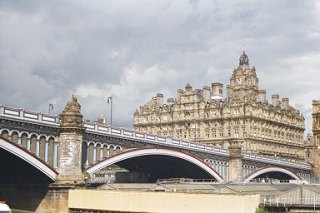
Lying at the E end of Edinburgh's Princes Street, North Bridge was the catalyst which finally brought about a northwards expansion of the city with the New Town. It provided a link from the Old Town to the south. The original bridge, which consisted of three stone-work arches and was 346m (1134 feet) long, was designed by architect William Mylne (1734 - 1790), with some assistance from John Adam (1721- 92). It was begun in 1765, but a design flaw resulted in a partial collapse which killed five people (1769) and thus it was not finally opened for use until 1772. Architect-mason David Henderson, who had failed to gain the initial contract to build the bridge, was called in to advise on the repairs. A protracted dispute developed between Mylne and the Town Council, who were unhappy with the delays and additional cost, but ultimately the Council recouped their money selling off adjoining land for development, which had risen in value thanks to the bridge. Beneath the bridge lay the fish-market and flesh-market. With the development of the railways, this became the site for Edinburgh's principal station, Waverley.
The original bridge was replaced by another by Sir William Arrol (1839 - 1913) between 1895-97. The foundation stone was laid on the 25th May 1896 by Lord Provost Sir Andrew McDonald and the bridge was constructed of steel girders laid between ornate sandstone ashlar piers, with decorative cast iron parapets, panels and light standards. During the 1990s, the ironwork was refurbished by Ballantine's Iron Foundry in Bo'ness, and given a distinctive colourful coat of paint. It is now subject to the highest levels of protection as a structure of historical and architectural interest.