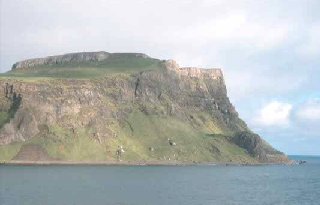
The most westerly of the Small Isles in the Inner Hebrides, Canna lies to the northwest of Rum, between Skye and South Uist. Accessed by ferry from Mallaig, Canna is 5 miles (8 km) long and a mile (1.6 km) wide, extending to an area of 1314 ha (3247 acres). Geologically it is a lava platform comprising terraced Tertiary basalt rock. It has a rich fertile soil and rises to 210m (690 feet) at Carn a' Ghaill. This combination of good soils and a sheltered harbour, linked to the island's position at a crossroads between the Outer Hebrides and the mainland of Scotland and between Skye and the islands of Argyll to the south, has made Canna an important island with a long and continuous settlement dating back to the Bronze Age. There are over 1000 archaeological features on the island whose earliest historical records are linked with St. Columba to whom a monastery on the island was dedicated. The island's last private owner was Dr. John Lorne Campbell who bought the island in 1938 and then gifted it to the National Trust for Scotland (NTS) in 1981. Included in the gift was Dr. Campbell's extensive and unique library of Gaelic language and literature. The population of the island, which had risen to 436 in 1821 from around 230 in the mid 18th Century, fell to 127 in 1861 as a result of Clearances and the failure of the kelp industry. This fall continued: 24 (1961), 22 (1971), 11 (1981), 20 (1991) and just 6 by 2001. In an attempt to arrest this decline, the NTS restored cottages for rent and issued a worldwide call for skilled people to come and live on the island. Success was limited, but the population was recorded as 12 in 2011. Canna is part of the Small Isles National Scenic Area, all of the island apart from the farm and inbye croft land being designated a site of Special Scientific Interest. Its cliffs are noted for their large numbers of breeding seabirds, the colony of shag being the largest in Scotland. Buildings of interest include the remains of the former township of A'Chill, the remnants of the 7th Century St. Columba's Chapel, Canna House, the Mediaeval cairn tower at An Coroghon and St. Edward's Church was for a time a study centre for visitors, but is now abandoned once again. At its southeast end, Canna is linked to the island of Sanday by a bridge and a reef.
Sea eagles have occupied the cliffs of Canna, spreading from Rum following their re-introduction there in 1975. Action was taken in 2005 to rid the island of rats which were devastating the island's sea-bird colony, while protecting the Canna mouse, a sub-species of wood-mouse unique to the island. In 2013, a cull the island's rabbits was announced, their population having grown to more than 16,000, owing to the lack of rats which had previously taken their young. Burrowing rabbits were blamed for causing a landslide and damaging archaeological sites.