A small residential town, Bridge of Allan is situated between the Allan Water and the wooded western end of the Ochil Hills, 2¼ miles (3.5 km) north of Stirling. The earliest record of a bridge here is from 1520, the remains of a predecessor to the present bridge being still visible in the river with its former parapet running towards an old corn mill (1710) that was part of the clachan of Bridgend, a community that eventually grew into Bridge of Allan.
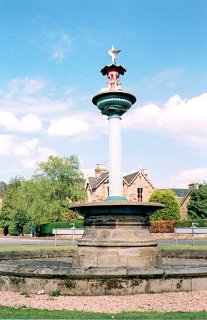
The village developed during the 19th Century as a spa resort, succeeding the clachan of Bridgend and the nearby settlement of Pathfoot which was the focal point of copper mining on the Airthrey Estate from the 16th century until 1815. The spa was developed by Sir Robert Abercrombie who was aware of the growing number of people visiting the Trossachs which had been popularised by Sir Walter Scott. The settlement expanded from 1846 with the arrival of the railway, its prosperity being reflected in a growing number of fine Victorian villas and public buildings including the Fountain of Nineveh, Museum Hall and Holy Trinity Church (1860). The village grew steadily in population from the 1960s to reach a population of 6762 in 2011.
Robert Louis Stevenson and Charles Dickens are among the many writers who visited Bridge of Allan during its heyday as a spa. Peculiarly, confederate agents such as George T. Sinclair and James H. North took up residence here during the American Civil War with the purpose of secretly negotiating with the Glasgow ship-builders to construct 'blockade runners', intended to bring weapons to the Southern States. The Pullar Memorial Park, which is the setting for the town's War Memorial, was donated to the community in 1923 by Edmund Pullar and the beautiful grounds of the Airthrey Estate below the Ochils are the setting for the University of Stirling which was founded in 1967. Bridge of Allan has a post office, police station, library, primary school, leisure centre, sporting facilities, golf club, hotels and churches.
The Bridge of Allan Highland Games takes place in August and is one of the largest in Central Scotland, attracting crowds of up to 10,000, with Chieftains including footballer Ally McCoist, actress Diana Rigg and tennis matriarch Judy Murray.