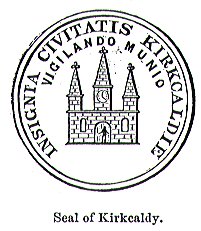
Known as the Lang Toun, Kirkcaldy stretches in a wide sweeping arc along the north shore of the Firth of Forth. It is the largest town in Fife and was the administrative centre of Kirkcaldy District from 1975 to 1996. Gifted to the monks of Dunfermline Abbey in 1364, the town's status as a royal burgh was confirmed by Charles II in 1661. Kirkcaldy grew up around its harbour near the mouth of the East Burn and expanded rapidly in the 19th century with the development of textile, linoleum and coal industries.
The linoleum industry was developed by Sir Michael Nairn from 1877 and became the town's largest employer, gaining an international reputation. The company diversified into vinyl floor-coverings in the 1960s but still makes linoleum as part of a Swiss-owned Forbo consortium. Kirkcaldy is also noted for the Fife Pottery of Robert Heron & Sons, which produced the famous Wemyss Ware between 1882 and 1929. Hutchison's Flour Mill has operated since 1830, and was rebuilt 2012-13 thanks to a £17-million investment by parent company Cumbria-based Carr's Milling Industries, the first new flour mill to be built in Scotland for 30 years. Smith Anderson who manufacture 60 million paper bags per week for fast food outlets were founded in Leslie in 1859 and moved from Falkland to Kirkcaldy in 2011.
Adam Smith (1723-90), the political economist and author of The Wealth of Nations came from Kirkcaldy and the novelist John Buchan (1875 - 1940) spent part of his early youth here. Buchan's sister Anna (1877 - 1948), the novelist O. Douglas, was born in Kirkcaldy and Thomas Carlyle taught here between 1816 and 1819. Other famous sons and daughters of Kirkcaldy include the architect Robert Adam (1728-92), Ebenezer Scroggie (1792 - 1836), who inspired Charles Dickens' character Ebenezer Scrooge, the African missionary Dr John Philp (1775 - 1851), Sir Sandford Fleming (1827 - 1915) who became Chief Engineer of the Canadian Pacific Railway and first proposed international time zones, architect Ian Begg (b.1925), Liberal politician Lord Steel of Aikwood (b.1938), darts player Jocky Wilson (1950 - 2012), Prime Minister Gordon Brown (b.1951), painter Jack Vettriano (b.1951), crime-writer Val McDermid (b.1955) and film director Richard Jobson (b.1960).
Today, Kirkcaldy encompasses the former burghs of Dysart, Linktown and Pathhead as well as the villages of Sinclairtown and Gallatown and part of the Raith Estate. Its town centre was designated a conservation area in 1980 and amongst many interesting buildings are the Old Parish Church with its Norman Tower, 15th-century Ravenscraig Castle, Sailor's Walk (1460), Kirkcaldy Museum and Art Gallery (1925), the Adam Smith Centre (1894-99), the Nordic-style Town House designed in 1937 by David Carr, Dunnikier House (built in the 1790s and now a hotel), Balwearie Community School dating from the 1960s, and St. Brycedale Church (1877-81) which rises to 60m (200 feet) and takes its name from Kirkcaldy's patron saint.
Kirkcaldy has one of Scotland's largest indoor markets. Fife College was founded in the town as Kirkcaldy Technical School in 1929 and now offers more than 200 courses through its three campuses in the town, while the University of Dundee operates a campus of its School of Nursing and Midwifery in the town, formed by merger with the former Fife College of Health Studies in 1996.
More information is available...