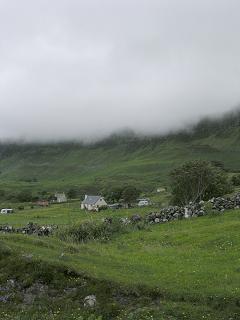
The most populous of the Small Isles in the Inner Hebrides, Eigg lies over 7 miles (11 km) west of mainland Inverness-shire, Highland Council Area. It is separated from the island of Rum by the Sound of Rum and from the island of Muck by the Sound of Eigg. It extends to 3049 ha (7534 acres) and its highest point is the prominent conical peak the Sgurr of Eigg (or An Sgùrr; 393m / 1198 feet), which is the largest residual mass of columnar pitchstone lava in the UK. The low-lying ground to the south overlies basalt, while the northern cliffs are of sandstone which erodes into curious shapes at the Camas Sgiotaig beach which is renowned for its 'singing' sands. In 1840 the fossilised remains of a 180-million-year-old Plesiosaur were discovered in shales found in the northeast corner of the island. The island's chief settlements are Kildonnan, Galmisdale, Cleadale and Laig on the Bay of Laig. The MacDonalds of Eigg sold the island in 1829 and successive absentee landowners held the island until 1997 when it was purchased by the community in the form of the Isle of Eigg Heritage Trust. The population of Eigg has fallen from a total of nearly 550 in the 1840s to 74 (1961) but is now relatively stable, recorded at 69 (1971), 64 (1981), 69 (1991), 67 (2001) and 83 (2011). At Kildonnan an ancient Celtic cross-slab stands near the ruins of a 14th century church which was built on the site of a monastery founded by St. Donnan in the 7th century. There are ferry links with the other Small Isles and the mainland from Galmisdale, although only passengers and permitted vehicles may land. Kenneth MacLeod, composer of songs such as The Road to the Isles was born on Eigg in 1871. The island was explored by the traveller Sarah Murray (1744 - 1811) in 1802, who wrote of it in the second volume of her Companion and Useful Guide to the Beauties of Scotland (1803) and by historian and television presenter Paul Murton during his Grand Tours of the Scottish Islands for the BBC in 2013.