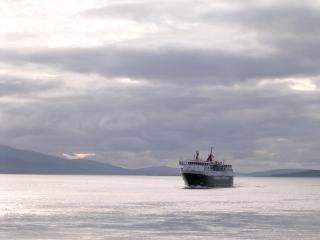
An island in the Inner Hebrides, Mull lies off the coast of Argyll and opposite the Morvern peninsula at the western entrance to the Firth of Lorn and Loch Linnhe. Largely of volcanic origin, its physical landscape comprises granite, gabbro and extensive basalt lava flows, Ben More (966m / 3185 feet) being the highest example of Tertiary basalt in Great Britain and the only 'Munro' peak in the Scottish islands. The Ross of Mull forms an extensive peninsula at the southwestern end of the island which is deeply indented with sea lochs and has an area of 87,794 ha (216,940 acres). Controlled from 1266 by the Lords of the Isles, Mull came to be associated with the MacDougall, MacDonald, MacKinnon and MacLean clans. The island's chief settlements are Tobermory, Salen, Calgary and Craignure and there are ferry links from Craignure with Oban on the mainland and from Fishnish on the Sound of Mull to Lochaline in Morvern. Ferries also connect with the islands of Iona and Ulva. The population of Mull reached a peak of 10,600 in the 1820s, but more recently it has been recorded as 2149 (1961), 2024 (1971), 2197 (1981), 2678 (1991), 2667 (2001) and 2800 (2011).
Places of interest include 13th-century Aros Castle, former home of the Lords of the Isles; Torosay Castle, a Scottish baronial castle designed in 1856 by David Bryce with terraced gardens laid out by Sir Robert Lorimer in 1899; Duart Castle, seat of the MacLeans of Duart; ruined Moy Castle, a former stronghold of the MacLaines of Lochbuie; and the Macquarie Mausoleum, the burial place of Lachlan Macquarie (1762 - 1824), Governor of New South Wales in Australia, who was born on Ulva. Crofting, fishing, sheep farming and tourism are the main industries. The classic Michael and Pressburger romance I Know Where I'm Going (1945), starring Finlay Currie (1878 - 1968), John Laurie (1897 - 1980) and Jean Cadell (1884 - 1967), was both set and filmed on Mull. Inaugurated in 1969 and taking place over three days in October, the Mull Rally is Britain's only closed-road motorsport event. Sea eagles can be observed on Mull, having spread here in 1985 from Rum where they were re-introduced in 1975.