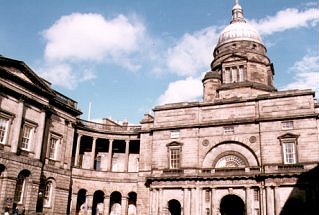
The University of Edinburgh obtained its charter from King James VI in 1582. The following year, it was established at Kirk o' Field, famous as the location of Lord Darnley's murder in 1567 and now occupied by the University's administrative centre in Old College. Edinburgh was Scotland's fourth University, at a time when England had only two, but the first founded by civic authorities. Originally the Tounis (or Town's) College, the University was at the centre of the Scottish Enlightenment.
Today, Edinburgh is Scotland's largest University with more than 45,500 students, 15,900 staff, an income of almost £1 billion (2022) and a host of buildings scattered throughout the south of the city,. These are primarily located around South Bridge, Holyrood Road, George Square, the King's Buildings on Mayfield Road and at the Bush Estate (Midlothian). The Old College, on South Bridge, is a dramatic building by Robert Adam (1728-92) and William Henry Playfair (1789 - 1857). New College houses the School of Divinity and lies next to the Assembly Hall of the Church of Scotland. It was built in 1846, to allow students belonging to the Free Church of Scotland, which had broken from the established Church in 1843, to be separately educated. Around New College is the Mylnes Court residential complex, perhaps the most spectacularly situated student residences in the world, with Edinburgh Castle as its neighbour. However, the University received considerable criticism during the 1960s for demolishing Georgian houses on two sides of George Square and building several large concrete buildings, including a new library which is now A-listed for its architectural importance.
Edinburgh's Medical School was founded as part of Old College in 1726, closely linked to professional bodies (Royal College of Physicians and Royal College of Surgeons of Edinburgh) and a teaching hospital (Royal Infirmary of Edinburgh). In 1884, a new Medical School building was opened on Teviot Place, following the move of the Royal Infirmary. Here the pre-clinical teaching remains, although the Medical School followed the Infirmary to Little France in 2002. Today, Edinburgh boasts the only unified College of Medicine and Veterinary Medicine in the UK.
Moray House College of Education, with its campus on Holyrood Road, was founded in 1835 and became part of the University in 1998. The Edinburgh College of Art merged with the University in 2011, absorbing the University's existing School of History of Art, Reid School of Music and School of Architecture.
The University also has a large student accommodation complex, Pollock Halls of Residence, by Holyrood Park and sports facilities at the Pleasance and Peffermill.
In addition to Nobel Prizes awarded to physicists Charles Barkla (1917), Max Born (1954) and Peter Higgs (2013), the University has provided the world with a number of technological innovations, including the world's first industrial robot (1969), an effective test and vaccine for Hepatitis-B (1980), the first miniature digital camera (1990), the world's smallest television screen (1999), together with wave energy, geophysical survey and carbon-capture technologies. The university is also home to Britain's oldest student newspaper, founded in 1887.
More information is available...