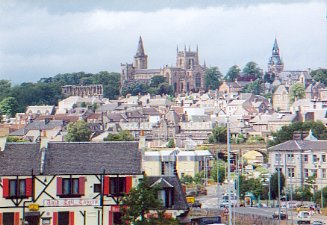
An historic city in W Fife, Dunfermline is situated 4 miles (6 km) northwest of the Forth Bridge. The only city and the largest centre of population in Fife, it has a history extending back over 1000 years to the foundation of a chapel by priests of the Celtic Church. It became an important centre and de-facto capital of Scotland when Malcolm Canmore moved his court here from Forteviot and built a fortress here c.1065. Canmore's second wife, Queen Margaret, established the town as an ecclesiastical centre, founding a Benedictine priory that was elevated to the status of an Abbey in 1128. In 1250 Queen Margaret was canonised and her tomb in the abbey became a shrine.
The importance of Dunfermline declined after the Reformation in the 16th Century although King James VI gave it a royal charter in 1588 prior to presenting the abbey to his wife as a wedding present. The town's economic fortune was revived during the 18th and 19th centuries with the development of the textile industry producing linen, cotton, woollen and damask goods. It remained a Royal Burgh until 1975 and was the administrative centre of Dunfermline District until 1996. It retains some importance in the administration of West Fife, while the old City Chambers (1876) remain prominent at the junction of Bridge Street and High Street.
Today Dunfermline forms the heart of the so-called 'Bridgehead Dunfermline' economic development area and has industries that include printing, financial services and the manufacture of soft drinks, textiles, windows, clothing, electronics, oil drilling equipment and call centres. Some of these industries are now located in the Elgin Street and Albany Industrial Estates and in the larger Pitreavie Business Park to the south of the burgh. An enormous Amazon fulfilment centre, the largest in Britain, opened in the Dunfermline Eastern Expansion area in 2011. Dunfermline became Scotland's 8th city in 2022 in celebration of Queen Elizabeth II's Platinum Jubilee, a status recognised by HM King Charles III by a visit shortly after his accession later the same year.
Born in Dunfermline were King David II (1324-71), King James I (1394 - 1437) and King Charles I (1600-49); poet Robert Henryson (1425 - 1508); philosopher Adam Blackwood (1539 - 1613); General John Forbes (1707-59); Admiral Sir Andrew Mitchell (1757 - 1806); artistic siblings Amelia Paton (1820 - 1904), Sir Joseph Noel Paton (1821 - 1901) and Waller Hugh Paton (1828-95); anatomist Sir John Struthers (1823-99); steel magnate and philanthropist Andrew Carnegie (1835 - 1919); antiquary Erskine Beveridge (1851 - 1920); architect James Shearer (1881 - 1962); authoress Dorothy Dunnett (1923 - 2001); ballerina Moira Shearer (1926 - 2006); singers Dan McCafferty (b.1946), Pete Agnew (b.1946), Ian Anderson (b.1947) and Barbara Dickson (b.1948), together with wildlife cameraman Doug Allan (b.1951), author Iain Banks (1954 - 2013), actor Dougray Scott (b.1965), curling champion Debbie Knox (b.1968) and paralympic rower David Smith (b.1978). Seven Scottish kings were buried in Dunfermline Abbey, the last being Robert the Bruce in 1329.
The town has many public parks, playing fields and community centres in addition to the Carnegie Centre swimming baths, East End Park which is the home of Dunfermline Football Club and three 18-hole golf courses (Canmore, Pitreavie and Pitfirrane). Queen Margaret and Lynebank hospitals lie to the east and retail parks have been developed near the town centre and at Halbeath to the east. The city benefits from the largest of Fife College's campuses and four secondary schools; namely Dunfermline High School (1468), Queen Anne High School (1790), Woodmill High School (1960) and St. Columba's High School (1969). Andrew Carnegie House is home to the four British-based Carnegie Trusts, each representing substantial charitable endowments.