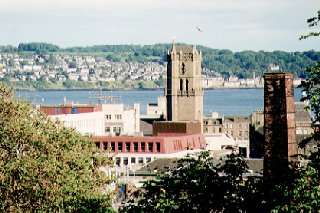
Dundee is a university city in the Midland Valley of Scotland, situated 22 miles (35 km) east of Perth between the Firth of Tay and the Sidlaw Hills and connected to Fife by rail and road bridges. A royal burgh since the 12th Century, it was constituted a city in 1889 at the height of its industrial development as a textile and jute milling centre. Having been the administrative centre of Tayside Region between 1972 and 1995, the city now forms its own local government area (Dundee City).
The city has several fine parks and golf courses as well as buildings of historic and architectural interest that include the Verdant Works Jute Mill, Baxter's Mills, Cox's Stack, St. Mary's Tower, St. Paul's Episcopal Church, St. Andrews Parish Church (1772), the Albert Institute (1867), Caird Hall, Dudhope Castle, Mills Observatory, Camperdown House, Mains of Fintry Castle, Claypotts Castle, Broughty Castle and the Wishart Arch, the last surviving gateway into the old town.
Other places of interest include The Howff, formerly the garden of the Greyfriars Monastery, Gardyne's House, dating from 1560, Olympia Leisure Centre, Victoria Dock, in which is anchored HMS Frigate Unicorn, the oldest British warship still afloat, and Discovery Point, home of RRS Discovery.
Once noted for its three "J's" - jute, jam and journalism - Dundee is now promoted as the 'City of Discovery', a title that reflects not only its links with exploration and Captain Scott's research ship Discovery, but the city's post-industrial role as a centre of scientific research, education and tourism.
The city's teaching and research establishments include the University of Dundee, which was founded as University College in 1881 and incorporated within the University of St. Andrews until 1967, Duncan of Jordanstone College of Art, now also part of the University of Dundee, together with the University of Abertay and Dundee College. Biomedical research and information technology are highlights amongst areas of research expertise. The city also has a thriving arts sector with the V&A Dundee, Dundee Contemporary Arts Centre, Dundee Repertory Theatre, McManus Galleries and Wasps Studios. Dundee was named the UK's first City of Design by UNESCO in 2014.
Dundee's principal industrial estates are located at Dundee Technology Park, West Pitkerro, Baldovie, Wester Gourdie, Kingsway East, Dryburgh, Dunsinane, Claverhouse and Riverside.
The city is also noted for its football; Dundee United Football Club play at Tannadice Park and Dundee Football Club play at the adjacent Dens Park.
More information is available...